

Featured, Publishing Voices
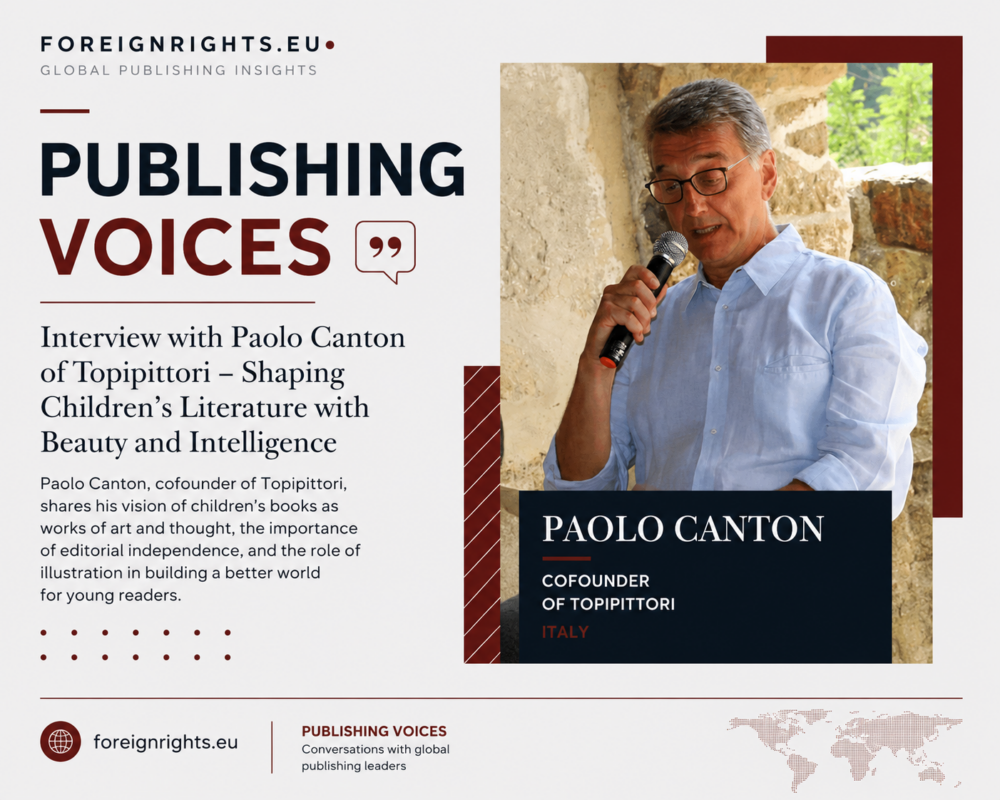
Interview with Paolo Canton of Topipittori – Shaping Children’s Literature with Beauty and Intelligence
Jul
From illustration and design to editorial vision and international reach, Paolo Canton discusses the principles that define Topipittori’s unique approach to children’s publishing.
When Topipittori was founded in Italy in 2004 by Paolo Canton and Giovanna Zoboli, the vision was clear yet ambitious: children’s books could be poetic, visually striking, and intellectually engaging all at once. Nearly two decades later, the independent publisher has become a reference point in Italian and European children’s literature, known for titles that respect the intelligence of young readers while offering beauty, innovation, and imagination. In this interview with Pigi Paideias’ editor Evangelia Tziaka, co-founder Paolo Canton reflects on the milestones that have shaped Topipittori, from nurturing new illustrators and authors to maintaining a distinctive visual and literary identity. He discusses the challenges and joys of independent publishing, the importance of international collaboration, and shares his hopes for connecting with creators and readers worldwide, including in Greece, highlighting the universal power of children’s literature to inspire curiosity, empathy, and wonder.
Could you introduce Topipittori to those who may not be familiar with it? What is the house’s core editorial vision?
Topipittori was created in 2004 by Giovanna Zoboli and me. The idea was to create books, picture books more specifically, which could be accepted in the international market. In order to do so, we thought it important to work with new illustrators and new authors on
innovative projects. After more than 20 years in activity, we published 370 books, 280 of them still reprinted and available in bookshops in Italy, and more than half of them published in at least one foreign language.
What distinguishes Topipittori’s approach to children’s publishing in the Italian and European market?
This is a tough question: I am not really qualified to establish what distinguishes us from our colleagues in Italy and Europe but I can tell you a few things we always try to be faithful to, which might probably contribute to the image we have in the market: we try to
respect children and their intelligence; we try to be correct in our relation with authors, illustrators, suppliers and fellow publishers; we try to stick to the idea that our work is not making books, but creating a catalogue, which is an ongoing conversation between us and
our readers.
How do you select the stories and illustrators you work with? What is the balance between text and visual narrative in your books?
The basic principle is; we only do what we like. This means we never judge a project from its commercial potential: if we love it, we are sure to find a few thousand people in the world who love it too. It is very difficult to define the balance between text and illustration in our books: the balance varies depending on the project, the qualities of texts and illustrations involved, other factors such as the graphic design and the production specifications. We always try to find this balance, which is unique to each book.
Your catalogue often emphasizes poetic, philosophical, and visually refined books. What drives that artistic direction?
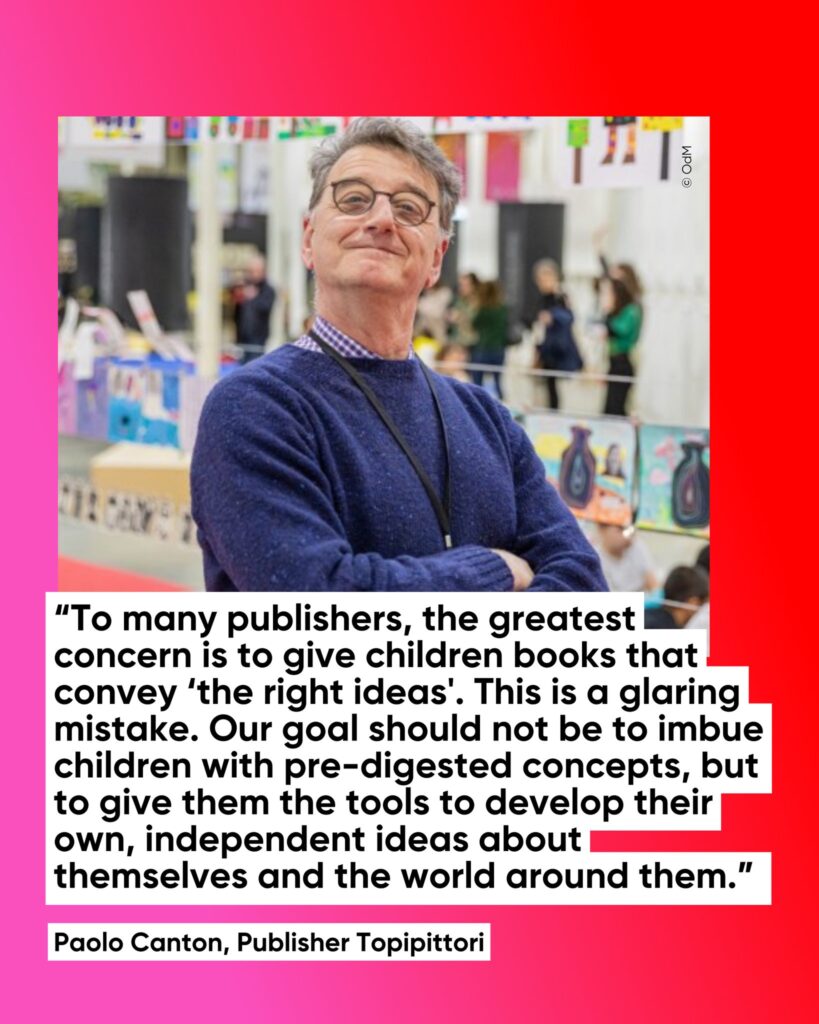
Our personal taste. There isn’t anything even vaguely resembling a marketing strategy. Our choices are determined by what we think children should read, not by what we think their parents are ready to buy. Working for children, to us, means offering them beautiful things. I had a friend, a rare example of British communist, who used to say: «Nothing is too good for the working class». The same concept applies to children: nothing is too good for them, if we want to educate them to the beauty an complexity of the world they
will leave in.
What challenges do you face in maintaining a strong visual and literary identity in today’s competitive market?
The challenges we are facing have very little to do with the competitiveness of the market. Of course, there are a lot of publishers who create an enormous amount of good or very good books. But to us, this is not a challenge it is a bounty. As Hannibal the Cannibal said:«Υou desire what you see every day». And if more and more people see good, innovative books every day, it is good for us, even if those books are created, produced and sold by other companies. The real challenge is to maintain a strong visual and literary identity, which for us means always do new, innovative things, while making them recognizable as “Made in Topipittori”.
How important are international book fairs like Bologna or Frankfurt for a publisher like Topipittori, especially in terms of rights sales and collaborations?
Weren’t it for the big international book fairs, we wouldn’t have survived. Everything happens there: you sell, you buy, you get to know new people and new projects, you feel the heartbeat of the creative community that keeps publishing alive. But I would also specify that it is not just the BIG International book fairs: in smaller, regional events (and especially through fellowship programs) you benefit of a more relaxed time, you get to know in depth the specific market, you create new relations and consolidate old ones.
What are some of your most successful or surprising international rights sales in recent years?
La Zuppa Lepron, by Giovanna Zoboli and Mariachiara Di Giorgio is an anti-capitalistic cautionary tale, has been sold in 21 languages in the last five years. But we pride ourself to have published also Che cos’è un bambino? By Beatrice Alemagna, in Italian bookshops since 2008, it sold more than 100.000 copies and has been translated into 22 languages.
Are you actively looking to collaborate with authors or illustrators from outside Italy, including countries like Greece?
We always do. Since the very beginning we looked for talents anywhere, from Italy to Iran, from France to Japan, from Germany to Uruguay or Colombia. We never had the chance to collaborate with Greek creators, though.
What advice would you give to new publishers or editors who want to focus on high-quality children’s literature?
Learn form the past. Trust your principles and ideas. Go global. Never forget who you are and where you come from.
How has the readership of children’s books changed over the years in Italy? What are young readers (and their parents) looking for today?
I have no idea of what young readers and their parents are looking for. And, if we had a magic wand, we wouldn’t use it for predicting the future. As I said above, publish books we think children should read, not those we think their parents are ready to buy. But there is something I would love to talk about: how different the present is from the recent past. Twenty years ago, in Italy, there wasn’t a market for picture books. Now, thanks to the efforts of a few small, independent publishers, a group of devoted booksellers, librarians and parents (I should say “mothers”) who actively created a strong movement for the development and the consolidation of a picture book culture in our country, more and more people know, appreciate, buy and use picture books. So this new market stemmed out of the basic need of people to offer better books to their children. This is making more and more difficult for publishers to create innovative, surprising books. But,
nonetheless, it makes our work happier, because we know we do not need to struggle to make our books understood and accepted.
What role does independent publishing play in shaping the future of children’s literature?
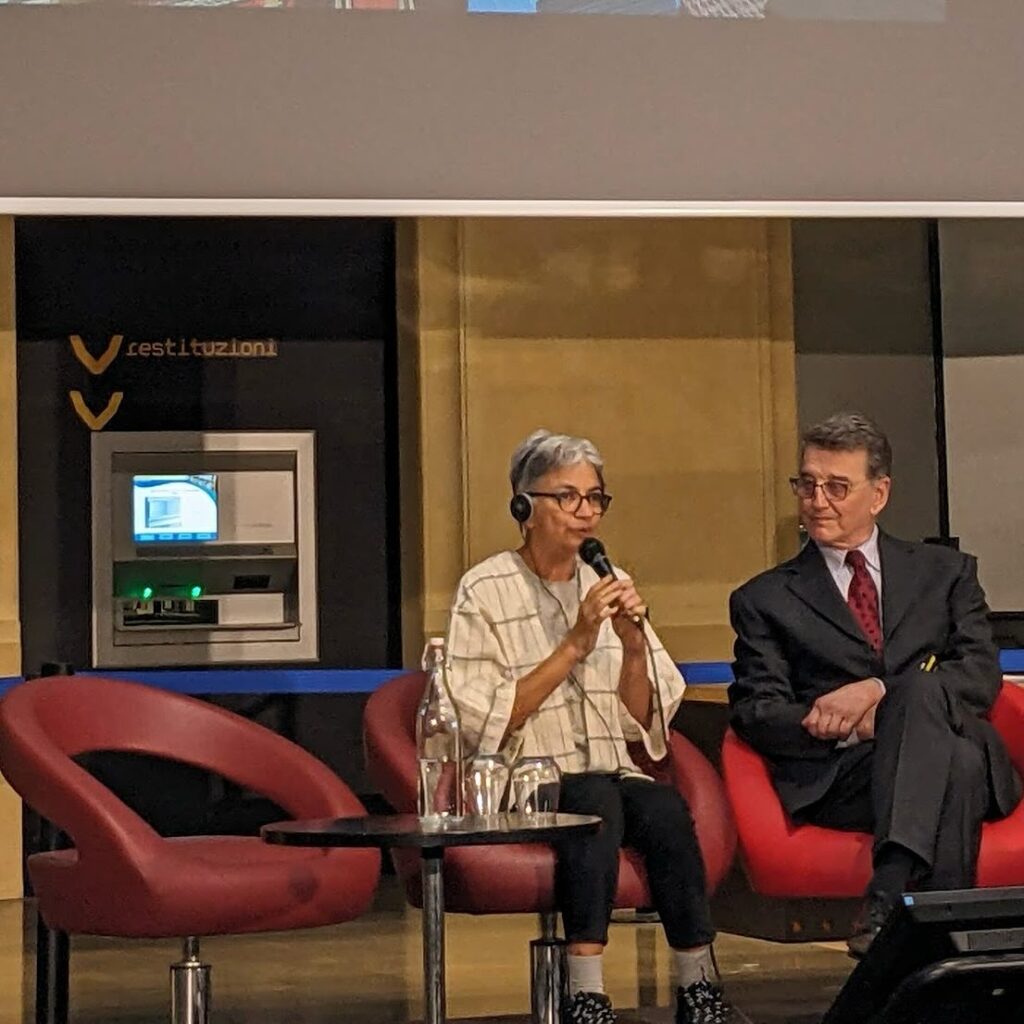
Usually, independent publishers are the engine of progress. It is with independent publishers that you can find new forms, new ideas, new authors and illustrators, new design. By being innovative, independent publishers bear the biggest part of the risk involved in – as you say – shaping the future of children’s literature. By being innovative, they fail all too often, but sometimes they succeed in giving shape to that something booksellers, librarians, children (and their adults) were looking for, but hadn’t yet found.
Looking ahead, what are your hopes for Topipittori’s presence in the international publishing scene?
After more than twenty years in publishing, we think we can say we are an “establishment”. So, the best hopes we may have is to keep on innovating the contents of our books, finding new ways and tools to reach our customer, strengthen the collaboration with colleagues worldwide. It will not be easy, as we are growing old, we will need new energies and resources. But we will do our best to try and do it.
Paolo Canton’s insights into Topipittori reveal a publishing house guided by curiosity, beauty, and respect for young readers’ intelligence. From nurturing new talent to maintaining a distinctive visual and literary identity, his reflections highlight the dedication, innovation, and collaborative spirit that have shaped two decades of remarkable children’s literature. We sincerely thank Paolo Canton for sharing his time and experiences, offering a rare glimpse into the heart and vision of Topipittori.
This interview was originally conducted for Pigi Paideias Project and is republished on ForeignRights.eu as part of the Publishing Voices series.
